Scroll, Drool, Cry: The Honest Baker's Guide to Surviving Cake Instagram Without Losing Your Mind (Or Your Spatula)
Photo: Localizedentirelywithinyourkitchen, CC BY-SA 4.0, via Wikimedia Commons
It starts innocently enough. You're lying on the couch, phone in hand, when the algorithm serves up the cake. Tiers so perfectly smooth they look machined. A color palette that belongs in an art museum. Flowers cascading down the side like they grew there on purpose. You double-tap, screenshot, and immediately text it to yourself with the caption "I'm making this for Sarah's birthday."
Sarah's birthday is in two weeks.
You have a hand mixer, one offset spatula, and the kind of oven that runs hot on the left side. Welcome to the Cake Instagram Industrial Complex, population: every home baker who has ever felt personally victimized by a Reels algorithm.
Here's the thing nobody tells you when you fall down the rabbit hole of cake inspiration content: a significant chunk of what you're looking at was created under conditions that have approximately zero overlap with your Tuesday evening kitchen situation. And that's not your fault. It's just the wild, glittery, occasionally fraudulent reality of baking content online.
The Smoke, Mirrors, and Ring Lights Behind That "Perfect" Cake
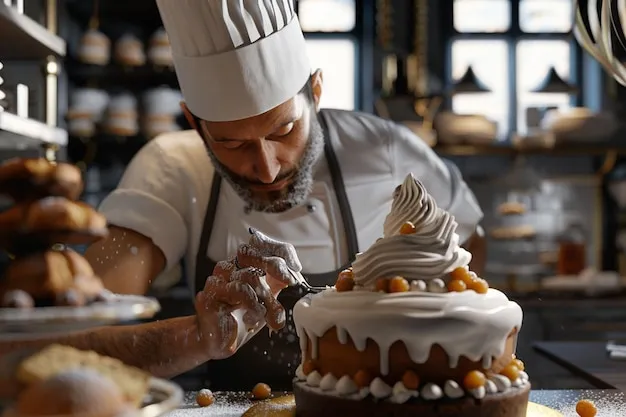
Professional cake photographers aren't just bakers — they're lighting engineers, color scientists, and occasional illusionists. A single hero shot of a wedding cake can involve multiple light sources, bounce cards, a custom backdrop, and post-production editing that smooths, sharpens, and saturates every pixel into submission.
That mirror glaze that looks like liquid gemstone? Gorgeous under a softbox. Under your kitchen fluorescents? More like a slightly reflective puddle. The color of that buttercream that stopped your scroll? Almost certainly shifted two to three shades in editing. And those ultra-clean, razor-sharp edges that look physically impossible? Sometimes they are — achieved with a final composite of multiple images or, increasingly, with AI-generated visuals that were never baked at all.
Yep. AI cake content is absolutely a thing now, and it's gorgeous, and it is completely made up. No flour was harmed in the creation of some of the most-saved cake images on the internet. The textures are too perfect, the geometry too precise, and the physics just slightly too cooperative to be real buttercream on a real planet Earth.
The Interview You Didn't Know You Needed
We talked to several professional decorators about how they handle client consultations when someone walks in with a screenshot of something that may or may not obey the laws of nature.
The consensus? It happens every single week.
"Someone will show me an image and I'll immediately know it's either AI, heavily edited, or was made by a team of people with a budget I'll never see," says one decorator based in Austin who asked to remain anonymous because, as she put it, "I don't want to become the person who told the internet their cake inspo isn't real." "My job is to figure out what they actually love about it — the color? The texture? The shape? — and then build something achievable that hits those same emotional notes."
That process of emotional reverse-engineering is, frankly, the most underrated skill in the cake world. It's not about replication. It's about translation.
How to Actually Reverse-Engineer a Viral Cake Design
Okay, let's get tactical. You've got your screenshot. Here's how to work backward from "impossible" to "impressively achievable."
Step one: Identify the hero element. What is the single thing that made you stop scrolling? The color? A specific texture? The overall silhouette? Nine times out of ten, there's one hero element doing all the heavy lifting, and everything else is supporting cast. Focus your energy there.
Step two: Ask if it's structural or decorative. Structural elements — gravity-defying tiers, extreme cantilevers, floating layers — require professional-grade internal armatures, specific dowel systems, and engineering knowledge that genuinely takes years to develop. Decorative elements — color palettes, surface textures, floral arrangements — are almost always more accessible than they look. If the hero element is structural, redirect. If it's decorative, keep reading.
Step three: Find the technique underneath the trend. That trendy "watercolor" cake finish? It's just a wet palette knife technique on buttercream that's been around for decades. The "brushstroke" cake? Melted chocolate painted onto parchment, chilled, and applied. Most viral aesthetics are built on classic techniques wearing fashionable outfits. Once you identify the underlying method, you can find tutorials that actually teach the fundamentals rather than just showcasing the finished result.
Step four: Adjust for your environment. This is the part nobody on Instagram talks about. Humidity wrecks Swiss meringue buttercream. A hot kitchen turns mirror glaze into a tragedy. Altitude changes how your cake layers bake entirely. Before you attempt any technique, spend five minutes researching how your specific climate and kitchen conditions interact with it. Your future self will be very grateful.
The Gear Gap Is Real (But Smaller Than You Think)
Here's some genuinely good news: the gap between professional cake equipment and home baker equipment has shrunk considerably in the last decade. A decent turntable, a good bench scraper, and a set of quality piping tips will get you further than you'd expect. You don't need an airbrush to achieve a soft ombre — a dry brush technique with petal dust works beautifully. You don't need a professional steamer to smooth fondant — a piece of acetate and warm hands go a long way.
The one thing worth actually investing in, if you're serious about leveling up your Instagram-inspired creations, is lighting for your photos. A cheap ring light and a neutral backdrop will make your very real, very imperfect cake look approximately 40% more like the thing you screenshotted. It's not deception. It's just understanding the medium.
When the Inspiration Is the Destination
Sometimes the best outcome of a wild cake screenshot isn't a perfect recreation — it's the cake you make because of it. You try to chase that ethereal blue-green palette and end up with a color that's entirely your own. You attempt a textured buttercream finish and develop a technique that becomes your signature. The inspiration is a starting point, not a finish line.
The decorators who seem to produce the most consistently stunning work aren't the ones who are best at copying. They're the ones who've internalized enough techniques that they can respond to inspiration creatively rather than literally.
So the next time the algorithm drops something jaw-dropping into your feed, by all means, screenshot it. Save it to your folder. Absolutely send it to yourself at midnight. Just remember that what you're looking at is the cake world's version of a movie trailer — curated, lit, edited, and sometimes entirely fictional.
Your kitchen is real. Your butter is real. Your slightly uneven oven is, unfortunately, very real.
And the cake you make anyway? That rocks harder than any AI render ever could.