Stack It Like You Mean It: The Engineering Secrets That Keep Showstopper Cakes From Becoming Pancakes
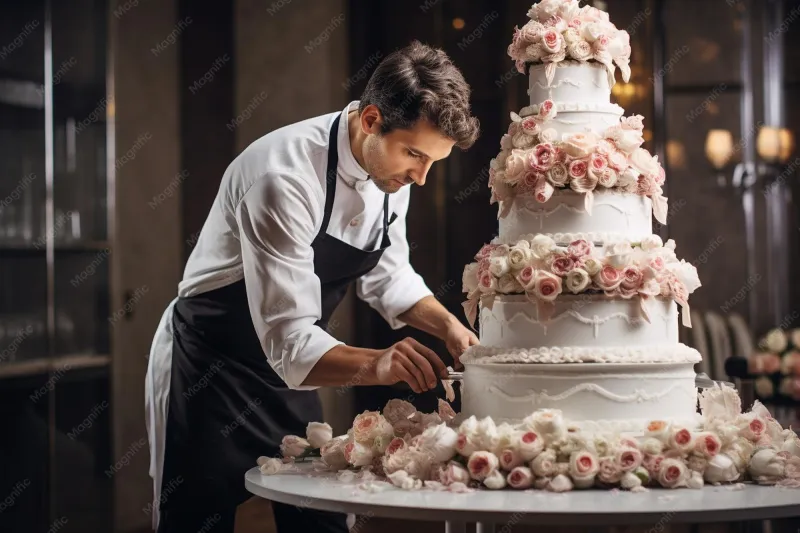
Photo: professional baker assembling multi-tier wedding cake with dowels and cake boards, via img.freepik.com
Let's talk about the moment every ambitious baker has experienced: you've spent two days constructing a four-tier masterpiece, you carefully transport it to the venue, and then — in what feels like slow-motion horror — you watch the top tier begin a very confident lean to the left. The cake has decided it's done. The cake is going rogue.
This does not have to be your story.
The most spectacular cakes you've ever seen — the ones that tilt at impossible angles, soar five tiers into the air, or appear to float mid-air over a cascade of sugar flowers — didn't survive on hope and prayers alone. They survived because someone understood the physics. And today, we're getting into it.
Cakes Are Buildings. Treat Them That Way.
The single most important mindset shift for any baker attempting serious tiered construction is this: a multi-tier cake is a small building. And buildings have structural systems.
Every skyscraper has a foundation, a load-bearing skeleton, and a plan for distributing weight so the whole thing doesn't compress under its own mass. Your five-tier birthday extravaganza needs the same respect. The frosting and the fondant are the curtain wall — beautiful, expressive, the part everyone photographs. But underneath? That's where the real magic lives.
Professional cake designers think about three fundamental forces before they ever start stacking: compression (the downward weight of each tier pressing on the one below), shear (the sideways forces that cause leaning and sliding), and tension (the forces acting on any internal supports). Understanding these forces isn't just nerdy fun — it's the difference between a cake that makes it to the toasting and one that doesn't make it out of the car.
The Foundation: Your Cake Board Is Not Optional
Every tier in a multi-tier cake needs its own rigid base — typically a cake board (also called a cake drum for the heavy-duty versions) cut to match the tier's diameter. This isn't about aesthetics. It's about creating a stable platform that distributes the tier's weight evenly and gives your support system something solid to work with.
For anything over three tiers or exceeding 30 pounds total, many professional bakers upgrade to a reinforced base — sometimes a half-inch thick wooden board or even a purpose-built cake plate with a non-slip surface. The bottom tier is carrying the weight of everything above it. Give it a foundation worthy of the job.
Dowels: The Unsung Heroes of Cake Architecture
If cake boards are the floors of your edible building, dowels are the columns. These are the load-bearing elements that prevent the tiers above from slowly, tragically compressing the tiers below.
The basic system works like this: before placing any tier on top of another, you insert a ring of vertical supports — traditionally wooden dowels, though food-safe plastic bubble tea straws, acrylic rods, and purpose-made plastic dowel systems are all popular alternatives — into the lower tier. These dowels are cut to exactly the height of that tier, creating a platform that transfers the weight of everything above to the cake board below, bypassing the cake itself entirely.
The number and placement of dowels matters enormously. A general rule among professionals: use at least four dowels arranged in a circle within the footprint of the tier above, plus one in the center. For heavier tiers or larger diameters, increase the count. The goal is to create a support ring that no single dowel is doing more work than it should.
Pro tip from the trenches: Always push your dowels to the bottom of the tier and mark the height before cutting. Even a millimeter of variation between dowel heights creates a tilt. And tilts, like bad rumors, only get worse as they travel upward.
The Central Dowel: Your Insurance Policy
For cakes with four or more tiers, or any design involving asymmetrical stacking, a central threaded rod running through the entire cake is the professional baker's equivalent of a safety net. This long rod — typically food-safe acrylic or stainless steel — passes through every tier and board, anchoring the whole structure from top to bottom.
It won't prevent every disaster, but it will absolutely prevent the "top half slides off in the car" scenario, which is the nightmare that haunts every wedding cake baker's dreams. Pair it with a nut and washer at the base to lock it in place, and you've just bought yourself significant peace of mind.
Gravity-Defying Designs: When Physics Gets Personal
Okay, so traditional stacked tiers are one thing. But what about those cakes that appear to float? The ones with tiers jutting out at 45-degree angles, or a single tier seemingly balanced on a thin chocolate spike? That's where cake engineering gets genuinely exciting — and genuinely complex.
These designs typically rely on one of two systems:
The hidden armature. A metal or acrylic internal framework — sometimes custom-fabricated for a specific design — provides the actual structural support, while the cake elements are attached to and around it. Think of it as building a sculpture and then covering it in cake. The "floating" tier isn't floating at all; it's bolted to a rod that runs through the tiers below.
The cantilever system. Borrowed directly from architectural engineering, a cantilever extends a horizontal support beam (usually a food-safe metal rod) from a central vertical support, allowing elements to extend outward without visible support underneath. The weight is counterbalanced on the opposite side, often hidden within the main structure.
These aren't beginner techniques — they require planning, often some CAD-level sketching before a single cake is baked, and a solid understanding of where the center of gravity lives in the finished design. But they're also why some cakes look genuinely impossible and people lose their minds at first glance.
Weight Distribution: The Math You Actually Need
Here's a simple rule that saves a lot of heartbreak: each tier should be significantly smaller than the one below it. The classic guideline is a 2-inch reduction in diameter per tier as you go up. This keeps the center of gravity low, reduces the load on lower tiers, and creates the visual tapering that makes tiered cakes look elegant rather than precarious.
Denser cakes — think pound cake, carrot cake, anything with heavy mix-ins — require more robust support systems than lighter sponges. If you're filling tiers with heavy elements like fresh fruit or mousse layers, factor that into your weight calculations. Mousse is delicious. Mousse is also dense. Mousse does not care about your timeline.
Before You Stack: The Checklist
Every tier on its own board. Every tier chilled firm before stacking. Dowels cut to exact height, verified with a level. Cake boards secured with a dab of buttercream to prevent sliding. Bottom board strong enough to carry everything. And — this cannot be stressed enough — a trial run with the transport setup before the actual event.
Because here at Cakes Rock, we believe in two things above all else: that cakes should look absolutely incredible, and that they should still look incredible when they arrive at the party.
Build it right, and your cake won't just defy gravity. It'll defy expectations.