Crystal Clear Delicious: The Wildly Nerdy (and Totally Edible) Science Behind Geode Cakes
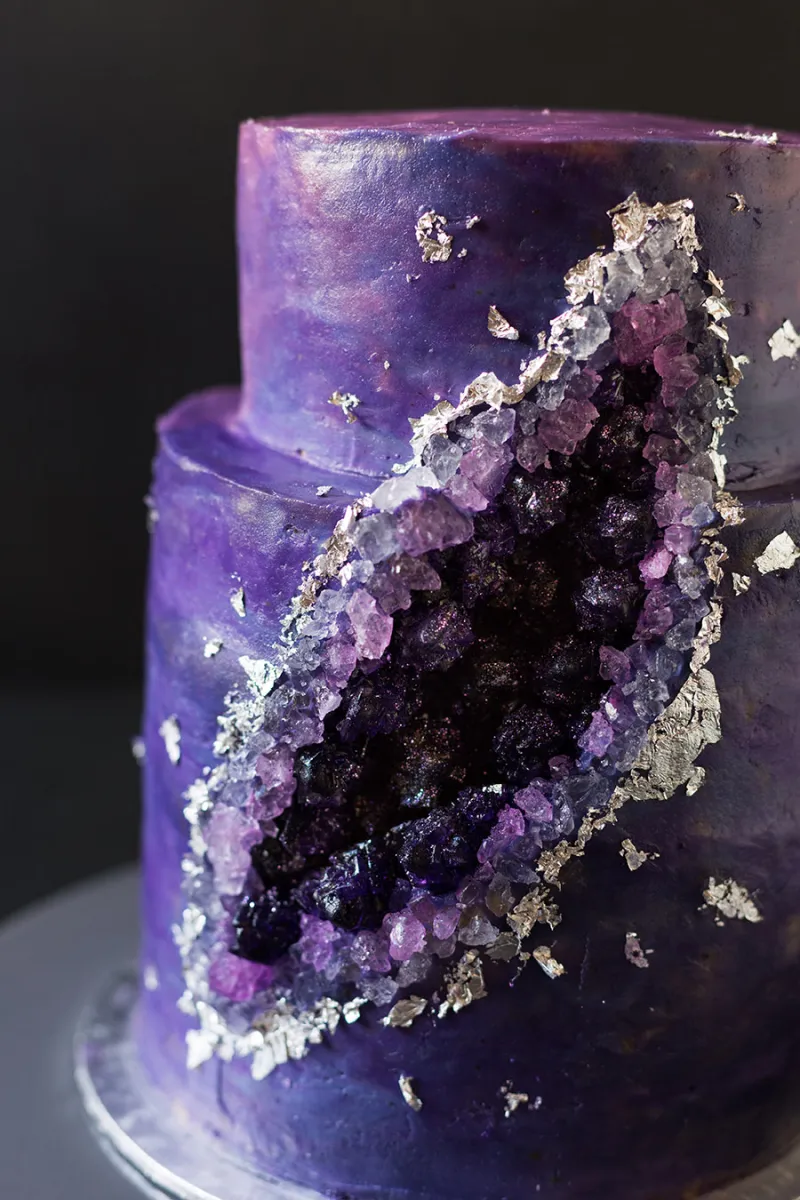
Photo: geode cake with purple crystal rock candy formation edible gemstone, via thekatetin.com
Somewhere around 2016, the internet collectively lost its mind over a cake. Not because it was the tallest, or the most elaborately frosted, or even the most delicious-looking — but because it appeared to contain an actual gemstone. A glittering, jewel-toned cavity filled with what looked unmistakably like amethyst crystals, nestled right into the side of a buttercream-covered confection.
Obviously, no one was mining for minerals in a commercial kitchen. What they were doing was something arguably more impressive: growing edible rock candy crystals using basic food chemistry, then engineering a structural cavity in a cake to house them. The geode cake trend was born, and it has been making pastry chefs and home bakers reach for their rock candy supplies ever since.
At Cakes Rock, we feel a particular kinship with this trend — because if any cake was designed to literally rock, it's this one. Let's break down exactly what's happening on a molecular level, how the colors get so vivid, and what it actually takes to pull this off in your own kitchen.
The Geology Bit (Stay With Us, It's Actually Cool)
Real geodes form over millions of years when gas bubbles in volcanic rock create hollow cavities. Mineral-rich water seeps in, and as conditions change — temperature, pressure, evaporation — dissolved minerals slowly crystallize on the interior walls. The result is those spectacular hollow rocks lined with quartz, amethyst, or citrine that you find in natural history museum gift shops for $40.
Edible geodes replicate this process in a dramatically compressed timeline using sugar instead of silica minerals. The underlying chemistry is identical in principle: you create a supersaturated solution (more dissolved solid than the liquid can comfortably hold at a given temperature), then allow it to cool and crystallize slowly on a seed surface. In nature, that process takes millennia. In your kitchen, it takes about a week — which still feels like forever when you're impatient, but is significantly better than geological time.
The key variable is supersaturation. When you dissolve sugar in boiling water, the elevated temperature allows far more sugar to dissolve than cold water could hold. As that solution cools, it becomes unstable — the sugar molecules want to return to solid form. If you provide a surface for them to grab onto (a string, a skewer, a rough-textured candy base), they'll begin forming organized crystalline structures rather than just clumping into a formless mass.
Growing Your Crystals: The Kitchen Chemistry Lab
Making rock candy at home is one of those projects that is simultaneously very simple and very unforgiving of impatience. Here's what's actually happening at each stage:
The Supersaturated Solution: The standard ratio for rock candy production is roughly 3 cups of granulated sugar dissolved into 1 cup of water, heated until completely clear. At this point, your solution contains far more dissolved sugar than it could hold at room temperature. It is, in chemical terms, primed and ready to crystallize.
Seeding the Surface: Before submerging your growing surface (traditionally a wooden skewer or rough string), you dampen it and roll it in dry granulated sugar. These tiny sugar granules act as nucleation sites — anchor points where the dissolved sugar molecules can latch on and begin building their crystalline structure. Without nucleation sites, the sugar tends to crystallize in a less organized, less visually spectacular way.
The Waiting Game: Once your seeded skewers are submerged in the solution and left undisturbed in a cool, consistent environment, crystal growth begins within 24 hours and continues for five to seven days. Vibration, temperature fluctuations, and premature disturbance are the enemies of good crystal formation — they disrupt the orderly molecular stacking process and result in smaller, less dramatic formations.
For geode cake applications, bakers often grow crystals directly on a rough sugar or isomalt base shaped to fit the cavity, rather than on skewers. Isomalt — a sugar substitute that melts at higher temperatures and sets with a glassy finish — is frequently used to create the shimmering interior walls of the geode before the crystals are added.
Color Me Geologically Accurate (or Gloriously Not)
Here's where bakers get to play god with geology. Real geodes come in nature's color palette: purple amethyst, white quartz, yellow citrine, blue celestite. Edible geodes come in literally any color you want, which is why you've seen everything from rose gold wedding geode cakes to electric teal ones that match a birthday theme.
The coloring process happens at multiple stages:
Tinting the Solution: Gel food coloring (not liquid — gel provides more concentrated pigment without disrupting the water-to-sugar ratio) is added to the supersaturated solution before crystal growth begins. The resulting crystals will take on that color as they form, though the shade often appears lighter and more luminous than the solution itself due to the way light refracts through the crystalline structure. This light-refracting quality is exactly what makes geode cakes look so gem-like in photographs.
Layering Colors: Advanced bakers create ombre effects within the geode cavity by using multiple crystal formations in graduating shades — deep violet at the outer edges transitioning to pale lavender and then clear at the center, mimicking the natural banding found in real amethyst. This requires growing separate crystal batches and assembling them strategically.
Luster Dust and Edible Metallic Paint: Once crystals are set and placed within the cake cavity, edible luster dust — finely milled metallic powder made from food-safe ingredients — is dry-brushed over the formations to add that unmistakable gemstone shimmer. Gold and rose gold are the most popular choices for wedding applications; silver reads more like raw quartz. This step alone transforms a nice-looking candy formation into something that genuinely looks like it belongs in a jewelry store.
Engineering the Cake Itself
All the gorgeous crystals in the world mean nothing if the cake structure can't support them. The geode cavity — typically carved into one or two tiers of a stacked cake — removes a significant amount of cake material from a load-bearing section. This requires some thoughtful structural planning.
Most professional bakers working with geode designs use denser cake varieties (chocolate mud cake and pound cake are popular choices) specifically because they hold their shape better when carved. Internal dowel systems are non-negotiable for multi-tier geode cakes, as the cavity can compromise the tier's ability to bear weight from above.
The cavity itself is usually carved after the cake is fully chilled and crumb-coated, then sealed with a thin layer of chocolate or isomalt to prevent the cake from absorbing moisture from the candy crystals over time. Moisture is the long-term enemy of rock candy — it will dissolve your carefully grown crystals if given enough time and humidity. This is why geode cakes are best assembled as close to serving time as possible and shouldn't be stored in a refrigerator without protective covering.
From Pinterest Fantasy to Your Actual Kitchen
The geode cake trend went viral because it occupies that perfect sweet spot of looks impossibly hard, is actually achievable with patience and the right materials. You don't need a professional pastry degree. You need:
- A willingness to start your rock candy growth a full week before your event
- Gel food coloring in your chosen palette
- Isomalt or a solid white chocolate base for the cavity walls
- Edible luster dust in gold or silver
- The emotional fortitude to not touch your crystals while they're growing
The science is real, the results are spectacular, and the look on people's faces when they realize they're eating something that looks like an actual geological specimen? Completely priceless.
At Cakes Rock, we believe the best cakes make people stop, stare, and immediately reach for their phones. Geode cakes do exactly that — and they taste better than any amethyst you've ever seen.